« For me, using the word queer is liberating.
It's a word that used to frighten me, but that's no longer the case.»
Derek Jarman
biography
" I am a queer artist. It’s the prism through which everything is viewed that determines my artistic work. A way of deconstructing and repairing
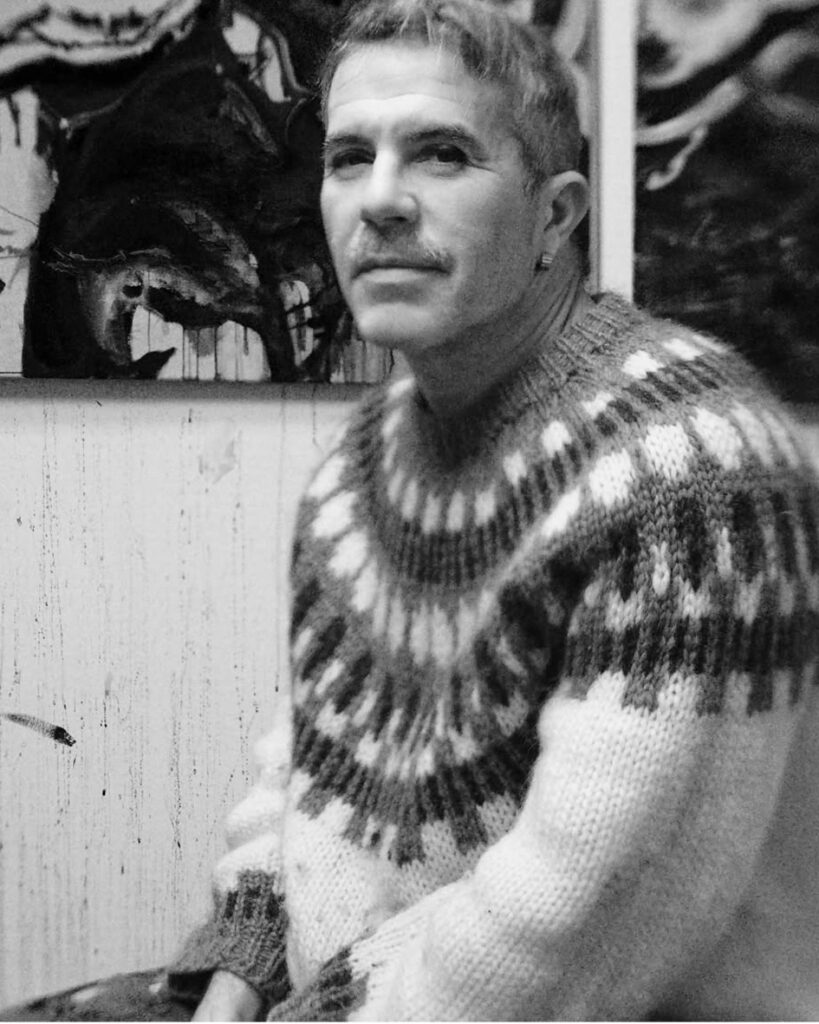
First a videographer, then an actor for theater and television, Samuel moved to Réunion Island in 2013. He graduated from the École Supérieure d’Art in 2017 at the age of 37 and began exhibiting his sculptures and paintings, which challenge heroic masculinity. At the same time, he became involved in the fight for LGBTQIA+ rights in the Indian Ocean, while also contributing to the island’s artistic scene.
Having been interested in the margins from a very young age, he immersed himself in a predominantly literary and theatrical gay culture where identity is portrayed as suffering and struggling against a short-term future. In his artistic world, the body, as a paradigm, interrogates space through its plastic and political form. While identity has long been defined by the body, his sculptures and paintings seek to make visible the silenced aspects of absent bodies and new queer identities. By queering representations of classical physicality, by blurring the boundaries of the realities of the flesh, between critique and homage, the gesture is envisioned as a utopian horizon.
It is in their native Brittany, where he returned to settle in 2024, that their research continues to explore the dominance of bodies, virility, and binary systems beyond normative identities. Samuel Perche now signs his work under the pseudonym sam·e.
approach
In my work, as in my life, I see the body as a means of deconstructing dominant masculinity by representing it, as well as the capacity of forms to produce, maintain, or fracture dominant gender systems. Refuting hegemonic masculinity, as an injunction, is, for me, a gesture that is simultaneously personal, political, and artistic.
Shifting masculinity from the register of domination to that of sensitivity does not mean replacing it with a «beyond gender», but rather, it involves challenging it from within, exposing its vulnerabilities by pushing it to its own excesses and breaking points. Occupying space with queer bodies constitutes an act of disobedience against the sexist and gender hierarchies that structure social violence. My work is rooted in this tension: it engages the body as a site of conflict, memory, and resistance. By using historically dominant codes (the masculine body, musculature, monumentality), I seek to disrupt the legibility of a political regime of representation.
The heroic male body, erected since Greco-Roman antiquity as a model of strength, constitutes both an acknowledged starting point and an ambiguous model. Based on personal and communal iconography, it represents a reversal of the stigma - «from the visual function to its function of making visible»1, I seek to render the body unstable, unsuitable for its normative function, and therefore vulnerable. The nude retains an emancipatory value – not as provocation, but as a formal anatomical device: it allows us to emphasize muscular and emotional tensions, morphological and social ruptures.
Against the legacy of a muscular body-measure as a surface of authoritarian and conquering power, I propose situated bodies, traversed by their histories and sexualities, activated by drives, collective legacies and movements; bodies marked, cracked by symbolic violence, but never reduced to their traumas: bodies in motion in search of a common balance.
The question of queer collective identity is explored as an unstable and malleable set of bodies in constant recomposition. Traversed by other norms and narratives that allow for the relinquishment of control over its form, this alternative morphology of the body becomes visible. «une sous-culture par laquelle il devient possible de se réapproprier ce qu’il nous a été interdit de montrer au grand jour.» 2
1 Quentin Petit-Dit-Duhal, Art queer : Histoire et théorie des représentations LGBTQIA+, Double Ponctuation éditions, mars 2024.
2 Tal Madesta, Désirer à tout prix, édition La Collection sur la table, 2022